
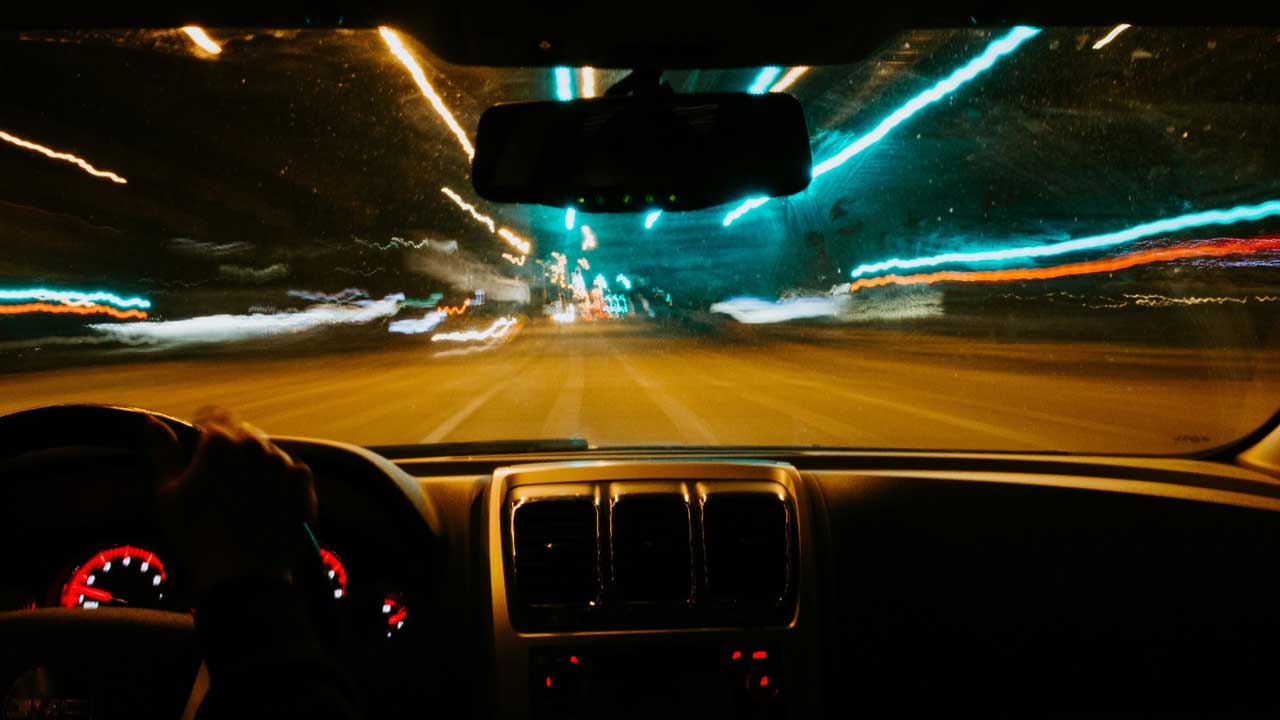
The chorus in my imaginary track starts with a train passing somewhere outside the frame. I want the video to catch that passing feeling without cutting to a stock clip of a train. Instead, a rectangle of light crosses the back seat of a parked car. It travels over an empty jacket and vanishes behind the window frame. That flash becomes the opening image of the hook. The verses stay close to the performer, shot in a borrowed rehearsal space with one overhead light. Moving from a face to an empty seat gives the chorus a different point of view without introducing a second storyline.
I would edit with a copy of the track on its own timeline and put markers on the sound effect, the first syllable, and the last snare before the chorus. The thing I am timing is the arrival of light, not the position of a visible train. One marker tells me where to start seeing the reflection. Another tells me how long I can leave the jacket in frame before the next line needs a face. If the words come in almost immediately, I can cut to the car a fraction earlier so the audience sees the seat before the room in the song changes.
Making a light pass from an ordinary photograph
On the storyboard, the car shot is written as a single action. Light enters, reveals a fold, and leaves. The still, the motion, and the sound come together in seedance 3.0 ai as references for a short generated insert. I can use a photo of an empty back seat I have permission to photograph, a phone clip of a lamp sliding across a jacket, and the relevant piece of the track. A text description can state that the camera stays low and fixed between the front seats. That position is close enough to see the folds without turning the jacket into a product shot.
I want the light to land at a shallow angle. A flashlight pointed straight at fabric flattens the folds and makes the jacket look like a bright patch on a dark screen. For the phone clip, I would ask a collaborator to move the lamp along the outside of the window at shoulder height. I can shoot two passes, one with a hard edge and one with light bouncing from a piece of white card. The window opening will stay in the same place in both clips. The useful reference is how the light disappears behind that edge.
What the camera sees in the verse
I would shoot the performance before finishing the car insert. For the verse I want a shoulder-level frame and enough room above the head to see the fixture casting light on the wall. In a close angle, I would turn slightly to catch a flash of cheekbone and one side of the performer’s hand as it rises on a line. That angle is useful near the end of the verse because the visible gesture can carry the cut. I won’t try to rebuild that performance with the video model. The delivery, timing of the mouth, and small hand movements belong to the filmed take.
On the timeline I can set the cut at the moment that hand falls. The empty seat comes in like the space the gesture just cleared. If the draft in seedance 3.0 ai begins with the seat already fully lit, it skips the image I am trying to make. I can adjust the motion reference to start in darkness or cut the clip at a different point. I want a small section of the stitching visible before the light hits the jacket. An entirely blank frame reads as an interruption. A trace of detail gives the flash something to reveal.
Adjusting the shape of the reflection
For the first pass in seedance 3.0 ai, I would keep the photo and audio fixed and vary only the motion clip. The harder edge may make the light feel like a police spotlight, especially if the light changes direction partway across the seat. That reading makes the frame too literal. A softer edge with consistent movement may feel more like something passing outside the car. I can compare both against the same verse ending and chorus entrance, then decide before doing any colour work. The decision is about what the reflection suggests in the track.
There is another revision I might make if the streetlight reads well but the fabric seems to slide. I would move the camera back a little and include more of the headrest as a stable reference. In the next seedance 3.0 ai brief, I can say that the jacket remains in place and only the reflection travels. If the folds still change visibly, I can trim the insert at the point where the light edge reaches the seam. A shorter shot could give the music room to complete the movement. It only needs to hold long enough for the eye to recognise the jacket.
The hook holds when the sound is muted
I would make a feed edit with captions for a line or two from the hook. The sound is important, but the moving rectangle should make sense in silence as well. On a narrow screen, I would centre the jacket seam and leave some of the window frame rather than cropping to the brightest part of the shot. That frame tells the viewer why the light suddenly cuts off. It also gives me a fixed dark edge where I can place a caption without putting it across the movement. I would look at the first frame, the moment the light reaches the cloth, and the cut back to the performer.
Near the end I want one more look at the seat. This time the reflection can disappear just before the final consonant of the hook. I can generate a slower seedance 3.0 ai version and try sliding it under the last line, but I may find that holding on the frame just after the reflection goes is enough. The return makes the jacket part of an image the viewer has already learnt to read. The performer gets the last close-up. Then the video can cut away on the breath between lines, leaving the seat and its passing light as a small piece of the song’s world.